 List
List
ATE is Advanced Technological Education. With an emphasis on two-year colleges, the National Science Foundation's ATE program focuses on the education of technicians for the high-technology fields that drive our nation's economy.
Hawaii International Conference on System Sciences
Conference
January 6 Lahaina, HI
Since 1968, the Hawaii International Conference on System Sciences (HICSS) has been known worldwide as the longest-standing working scientific conferences in Information Technology Management. HICSS provides a highly interactive working environment for top scholars from academia and the industry from over 60 countries to exchange ideas in various areas of information, computer, and system sciences. According to Microsoft Academic, HICSS ranks the 36th in terms of citations among 4,444 conferences in all fields worldwide.
(View More)
Scouting America Badging Day
Student Event
January 10 Thief River Falls, MN
Scouting America Merit Badge Day will be held at Northland Community & Technical College. Scouts will have the opportunity to participate in a variety of engaging classes, including Aviation, First Aid, Welding, Law Enforcement, and Citizenship in the Nation. This event is designed to give Scouts hands-on learning experiences while working toward their merit badges.
(View More)
KidWind - Wind Energy 101
Workshop
January 10 Online
Join for this wind-focused, three-hour virtual workshop to explore the science of wind power!
During this virtual workshop, educators will learn the foundations of wind power including the science and technology of wind turbines and blade design. Presenters will also introduce activities for the classroom that engage students in dynamic, hands-on energy-based learning.
Registration closes December 27th so you receive materials prior to the workshop.
(View More)
Generative AI and Microsoft Copilot Training for Community College Faculty and Staff: 101
Webinar
January 15
This session is designed for community college faculty and staff exploring the fundamentals of Generative AI and Microsoft Copilot. Topics include Generative AI and responsible AI use, effective prompting techniques, and real-world applications in education. This session will provide practical insights and hands-on guidance to help integrate AI tools into your work.
(View More)
NCyTE Monthly Meeting: Evaluating CAE Cybersecurity Career Outcomes
Webinar
January 16
Join NCyTE’s January Monthly Meeting where Dr. Tobi West will share her research into how well Centers of Academic Excellence in Cybersecurity (CAE-C) programs prepare students for cybersecurity careers.
The session will highlight findings from a ten-month study involving 281 students from 36 colleges and universities across the U.S. The research examined the types of cybersecurity jobs CAE alumni secured after graduation and assessed how closely those positions align with the 52 cybersecurity work roles defined in the recently updated NICE Workforce Framework for Cybersecurity (NIST).
Presenter: Dr. Tobi West
(View More)
Google's Generative AI Leader Training and Certification
Meeting
January 16 Online
Become one of the first go-to resources and thought leaders in Generative AI Leadership, enhancing your visibility and influence within the organization. This no-cost opportunity, funded by Google Cloud’s Career Launchpad, and in collaboration with NAAIC, will prepare community college faculty for the Google Cloud Generative AI Leader certification.
The training will cover:
- Fundamentals of Gen AI
- Google Cloud's Gen AI offerings
- Techniques to improve Gen AI model output
- Gen AI business strategies
Training sessions
Session 1: January 16, 2026, 10 to 4:30 PM EST, online
Session 2: January 23, 2026, 10 to 4:30 PM EST, online
Office hours (optional): January 30, 2:30 to 4 PM EST, online
Certification exam deadline: January 31, 2026
(View More)
Octet Bio-Layer Interferometry: Accelerating Breakthroughs in Biologics Development
Webinar
January 16
Discover how Octet Bio-Layer Interferometry (BLI) is transforming the landscape of biologics research and development. In this webinar, Dr. Rodrigo Jacamo will showcase the unmatched capabilities of Octet BLI in streamlining workflows across cell line development, antibody discovery, drug development, cell therapy, and gene therapy. Whether you're optimizing clone selection, characterizing binding kinetics, or accelerating therapeutic screening, Octet BLI delivers real-time, label-free analysis with exceptional sensitivity and throughput.
Learn how leading scientists are leveraging Octet systems to reduce timelines, increase data confidence, and make faster decisions in critical stages of development. Experts will walk you through application-specific case studies, demonstrate assay versatility, and answer your questions live.
(View More)
SPIE Photonics West 2026
Conference
January 19 Online
SPIE Photonics West is the premier event for lasers, biomedical optics, optoelectronics, and technologies supporting biophotonic, quantum, and vision applications.
View the lineup of outstanding plenary speakers from around the globe. Select advanced training from 60 course options. Discuss your product requirements with top optics and photonics suppliers at any of the five exhibitions throughout the week, and participate in the strong industry program – this year now on three stages!
(View More)
Generative AI and Microsoft Copilot for Community College Faculty: 102
Webinar
January 20
This follow-up webinar is designed for faculty looking to integrate Generative AI and Microsoft Copilot into their curriculum. We'll start with a brief review of Copilot Chat, then explore practical strategies for incorporating AI-driven tools into lesson plans. We'll also examine real-world use cases from various disciplines.
(View More)
Generative AI and Microsoft Copilot for Community College Faculty: 102
Webinar
January 20
This follow-up webinar is designed for faculty looking to integrate Generative AI and Microsoft Copilot into their curriculum. We'll start with a brief review of Copilot Chat, then explore practical strategies for incorporating AI-driven tools into lesson plans. We'll also examine real-world use cases from various disciplines.
(View More)
Community Capabilities Webinar | The NCERC Experience
Webinar
January 21
The National Corn-to-Ethanol Research Center (NCERC) at Southern Illinois University Edwardsville is a nationally recognized Biorefining Center of Excellence dedicated to advancing the commercialization of biofuels, biochemicals, biomaterials, and other bio-based products. NCERC offers a comprehensive range of workforce development programs, including job shadowing, internships, graduate assistantships, and visiting research fellow programs, as well as professional workshops. Through the various programs, trainees gain real-world experience inside a functioning biomanufacturing pilot plant and are equipped with the skills needed to lead in a rapidly evolving biobased economy.
(View More)
Microsoft Azure AI-900 Training
Webinar
January 23
Are you a community college faculty member eager to equip your students with the AI skills employers are seeking right now? To help you become a confident instructor of Microsoft AI content, you are invited to apply for a complimentary, two-day train-the-trainer bootcamp designed to fully prepare you for the AI-900: Microsoft Azure AI Fundamentals certification. This intensive program also introduces you to Microsoft Learn for Educators (MSLE), offering access to official courseware, hands-on labs, and curated teaching resources.
The online training will be delivered by Black Dog Black Cat, a Microsoft Certified Trainer, and will include materials, labs, and resources. AI-900: Microsoft Azure AI Fundamentals certification exam vouchers will be available to all educators who successfully complete both training sessions. Online proctoring will be available at a discounted rate of ~$30 and instructions on how to take your certification exam online will be provided.
Following the training, a Teams channel will be available for the MSLE AI Bootcamp educators, including training materials, session recordings, and a forum to post your questions regarding MSLE access and the AI-900 certification exam.
(View More)
Introducing BioSuite Virtual: Immersive Biomanufacturing Training for Tomorrow’s Workforce
Webinar
January 23
Join Jared DeCoste and Dan Beaupré of Prism Immersive for an introduction to BioSuite Virtual—a mixed-reality training platform developed to expand access to high-quality, job-ready biomanufacturing education.
Developed with industry and academic support and integrated with BioSciences Core Skills Institute (BCSI) credentials, BioSuite Virtual enables learners to perform end-to-end upstream bioprocesses—from bioreactor assembly and aseptic technique to fermentation monitoring and analysis—within an interactive virtual laboratory. Its innovative learning design contextualizes the development of critical skills with the guidance and flexibility needed for effective, self-paced learning.
(View More)
ATE Projects and Centers

Mfg
Advanced Manufacturing Technologies topics include:
- Additive manufacturing
- Automotive manufacturing
- General manufacturing
Ag/Env
Agricultural and Environmental Technologies topics include:
- Agriculture and aquaculture
- Environmental technologies
- Natural resources
- Nuclear power
- Solar energy
- Wind power
Bio/Chem
Bio and Chemical Technologies topics include:
- Biotechnology
- Chemical and process technologies
Eng
Engineering Technologies topics include:
- Electronics and controls
- General engineering
- Marine technologies
- Materials technologies
- Optics
- Space technologies
Gen
General Advanced Technological Education topics include:
- Evaluation
- Learning research
- Recruitment
- Teacher preparation
Info
Information and Security Technologies topics include:
- Geospatial technologies
- Information and communications technologies
- Logistics
- Security, information assurance, and forensics
Nano
Micro and Nanotechnologies topics include:
- MEMS
- Microsystems
- Semiconductors

This 17-page article, provided by Indian River State College, presents the results of a quantum industry survey on the skills and competencies necessary in a quantum technician workforce, followed by recommendations for quantum technician curricula based on the survey results. The article provides an overview of the quantum industry in the United States and an analysis of current quantum education programs, highlighting the insufficient technical training in quantum technologies to meet the projected need for a quantum technician workforce. Additionally, the article discusses the EdQuantum project, which aims to create a curriculum in quantum technologies for technicians.
(View More)

This experiment, presented by the National Nanotechnology Coordinated Infrastructure, covers Shape Memory Alloys or Smart Materials. A Smart Material or Shape Memory Alloys belongs to a class of materials which displays the shape memory effect (SME); they possess the ability to radically change crystal structure or phase at a distinct temperature. The lab will "explore how smart materials work and what applications these materials are used in." Additionally, students will be provided with a brief history lesson about the origins of smart material. The experiment is quite fun, students will observe how smart materials can "think and do amazing things." A student and teacher guide is provided with the lab.
(View More)

This issue of J ATE, published by Portland Community College, focuses on the theme of professional engagement. J ATE is a peer-reviewed technical journal focused on community college faculty and staff who work with technician education. This journal is cross-disciplinary and encompasses all technologies under the National Science Foundation (NSF) Advanced Technological Education (ATE) Program. Some of these technologies include: Micro Nano, Biotechnology, Autonomous Technology, Cyber Security, Advanced Manufacturing, Earth Sciences, Agriculture Technology, Energy, and Welding. Some topics that cross cut across all disciplines of technician education are also covered. Those topics include: Evaluation, Mentoring, Undergraduate Research, and Applied Technician Research.
This 108-page issue of J ATE includes 11 full articles and five guest letters written by ATE professionals. Listed below is each article and corresponding DOI number in parentheses.
- Building a Well-Equipped Skilled...
(View More)

These free, online Agricultural Biotechnology course materials from Futurelab+ make up a 36-week course that investigates "the amazing ways that living organisms can be harnessed to improve agriculture processes and redefine a healthier relationship with the natural environment." The course consists of four units, each featuring an introductory video, various lessons with lab elements, core labs, and projects. Each lesson and lab has a downloadable instructor's guide with student worksheets. Along with lesson content, the instructor's guides include pedagogical framing, national learning standards met by the lesson, and more. Editable versions of the student materials are available in both English and Spanish. Additionally, each unit includes a pacing guide, lesson flowchart, and lab materials. The units are as follows:
- Solution Seeking Microbes
- Alternative Proteins
- Plant to Pharmaceutical
- Community Science
The Futurelab+ biomedicine course, which this course builds on, is...
(View More)

This video from the Internet Scout Research Group is part of a series that highlights student success stories related to advanced technological education (ATE) programs. In this video, Sam Martinich discusses his experiences with Central Wyoming College's geospatial information systems and technologies (GIST) program. Topics covered include Sam's career path and journey to Central Wyoming College, the impact of the program on his life, and his work collecting climate data. Funding for the program from the National Science Foundation (NSF) is also explored.
The video runs 5:38 minutes in length.
(View More)
| Active ATE Centers | 15 |
| Active ATE Projects | 291 |
| ATE Resources | 6,982 |
| New Projects/Centers | 62 |
| New Resources | 74 |
ATE Resources by Subject Area
ATE Events by Subject Area
New Research: Dual Enrollment Experience Shows Increased College Completion Rates
A new analysis from the National Student Clearinghouse (NSC) Research Center highlights the continued influence of dual enrollment on college completion, particularly within community colleges.
For the 2019 cohort at public two-year institutions, students who entered with dual-enrollment credits achieved a six-year completion rate of 57%, far outpacing the 39.6% rate of those without early college coursework.
Despite the strong outcomes among dual-enrollment students, the national six-year completion rate for community colleges held at 43.9% for the most recent cohort, matching the previous year's. This still represents an increase from 2008 levels.
To explore additional breakdowns by state, demographic group, and enrollment status, view NSC Research Center's full report.
(View More)
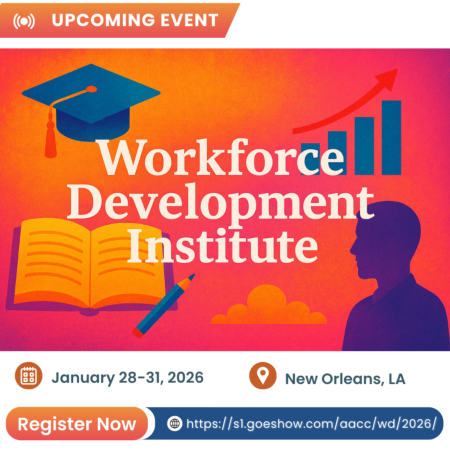
Upcoming Event: Workforce Development Institute 2026
Registration is now open for the American Association of Community Colleges' (AACC) annual Workforce Development Institute (WDI). The conference will be held January 28 through January 31, 2026, in New Orleans, Louisiana.
WDI will bring together community colleges faculty, industry leaders, and government partners committed to developing and strengthening the national workforce pipeline. Attendees will have the opportunity to engage with plenaries, exhibit halls, speakers panels, and executive-listening sessions across a variety of topic pertinent to community colleges and workforce development. Pre-conference programming is also available.
To learn more or to register for AACC's 2026 Workforce Development Institute, visit the conference's website.
(View More)

New Research: Increasing Cost of Community College Education
A new College Board report shows that the average published tuition and fees for in-district, full-time students at public two-year colleges in 2025–2026 reached $4,150, an increase of $110 from last year.
State-level prices varied widely, from $1,440 in California to $8,900 in Vermont, and only nine states saw no change or increases of less than 1%.
To learn more about trends in college tuition and financial aid, read the full report from College Board.
(View More)